Particle Board Export Business from India: Complete Guide to Starting a Profitable Export Business
A Practical International Business Opportunity The Particle Board Export Business is an interesting opportunity for Indian manufacturers, traders, merchant exporters, furniture suppliers, and new entrepreneurs looking to enter the international market. Particle board is an engineered wood product widely used in furniture manufacturing, modular kitchens, wardrobes, office furniture, shelves, partitions, doors, interior projects, and commercial fit-outs. 🌍 As global furniture and interior industries continue to develop, international buyers require consistent supplies of affordable and reliable engineered wood panels. India has a strong manufacturing ecosystem, access to raw materials, skilled labor, and established logistics infrastructure, making particle board export from India worth exploring. This guide explains how an entrepreneur can understand the product, identify suppliers, find international buyers, calculate export prices, manage documentation, and develop a practical export strategy.

A Practical International Business Opportunity The Particle Board Export Business is an interesting opportunity for Indian manufacturers, traders, merchant exporters, furniture suppliers, and new entrepreneurs looking to enter the international market. Particle board is an engineered wood product widely used in furniture manufacturing, modular kitchens, wardrobes, office furniture, shelves, partitions, doors, interior projects, and commercial fit-outs. 🌍 As global furniture and interior industries continue to develop, international buyers require consistent supplies of affordable and reliable engineered wood panels. India has a strong manufacturing ecosystem, access to raw materials, skilled labor, and established logistics infrastructure, making particle board export from India worth exploring. This guide explains how an entrepreneur can understand the product, identify suppliers, find international buyers, calculate export prices, manage documentation, and develop a practical export strategy.
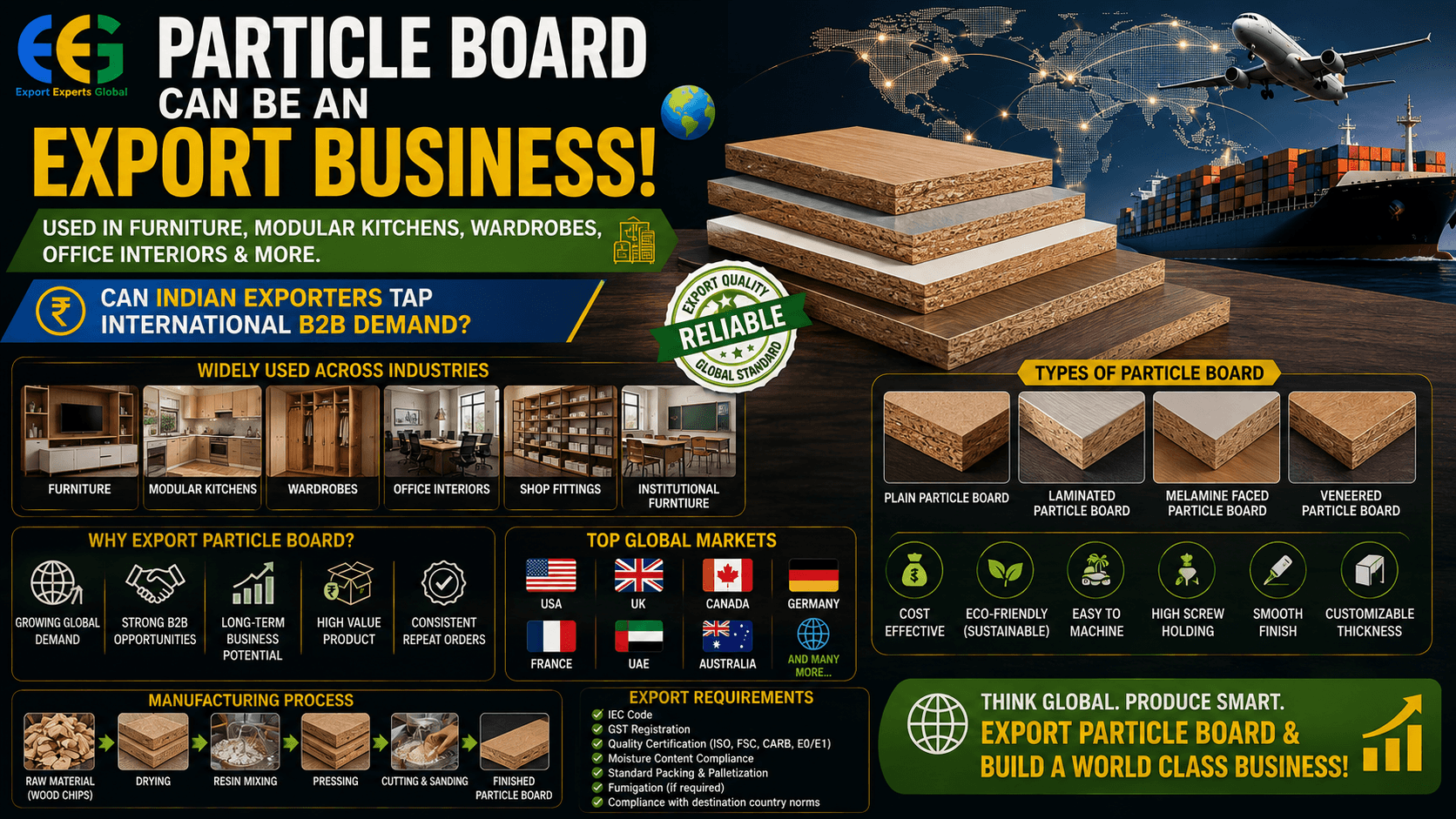
What Is Particle Board?
Particle board is a type of engineered wood panel produced by combining wood-based materials such as wood chips, flakes, sawdust, and other wood waste with adhesives or resins. These materials are compressed under controlled heat and pressure to create strong, standardized boards.
Unlike natural solid wood, particle board is manufactured according to predefined sizes, thicknesses, and technical requirements. This standardization makes it suitable for industries that need consistent panel dimensions and specifications.
Particle board is available in various:
- Thicknesses
- Panel dimensions
- Surface finishes
- Moisture-resistance levels
- Fire-performance specifications
- Furniture grades
- Decorative patterns and designs
Depending on the application, manufacturers may supply particle boards in raw form or with pre-laminated and melamine-faced surfaces.
Why Consider Particle Board Export?
The growing furniture, interior-design, and construction industries continue to create demand for engineered wood products in international markets.
Particle boards are commonly used by manufacturers to produce:
- Tables
- Cabinets
- Bedroom furniture
- Modular kitchens
- Bookshelves
- Storage systems
- Office furniture
- Interior partitions
For exporters, this creates an opportunity to supply products directly to furniture manufacturers, importers, distributors, contractors, and project suppliers instead of relying only on domestic retail sales.
Particle board should generally be viewed as a B2B, volume-driven export product. Long-term success depends on maintaining competitive pricing, consistent product quality, dependable logistics, and strong relationships with repeat buyers.
Types of Particle Board You Can Export
Choosing the appropriate particle board category is an important first step when entering the export market.
Plain Particle Board
Plain particle board is a basic engineered wood panel without a decorative outer layer.
It is often purchased by furniture manufacturers and processors that intend to apply their own laminate, veneer, paint, or other finishing materials.
Pre-Laminated Particle Board
Pre-laminated particle boards come with a decorative surface applied during the manufacturing process.
Because the finishing work is already completed, these boards can help furniture manufacturers reduce additional processing and production time.
Melamine-Faced Particle Board
Melamine-faced particle board, commonly known as MFC, is frequently used for furniture and interior applications where buyers require an attractive and reasonably durable finished surface.
Manufacturers may offer different colors, textures, patterns, and wood-inspired finishes depending on their product range.
Moisture-Resistant Particle Board
Certain applications require boards capable of handling environments where humidity or moisture exposure may occur.
In such cases, buyers may specifically request boards with defined moisture-resistance properties. Exporters should only make technical or performance claims that are supported by proper manufacturer documentation or test reports.
Decorative Particle Board
Particle boards with decorative surfaces can provide additional opportunities in furniture manufacturing and interior-design projects.
Customized Boards
International buyers may sometimes request customized products based on their individual procurement requirements, including:
- Specific panel dimensions
- Required thicknesses
- Particular surface finishes
- Private labeling
- Customized packaging
Offering customization can help exporters differentiate themselves instead of competing purely on price.
Who Buys Particle Board Internationally?
One common mistake among new exporters is focusing exclusively on companies searching for "particle board importers."
A better approach is to identify the industries and businesses that actually use particle board in their operations.
Potential customers include:
- Furniture manufacturers
- Modular kitchen manufacturers
- Door manufacturers
- Office furniture manufacturers
- Interior contractors
- Building-material distributors
- Wood-product manufacturers
- Furniture wholesalers
- Home-improvement suppliers
- Importers and distributors
A furniture manufacturer can potentially become a stronger long-term customer than a general trading company because manufacturing businesses may require regular and repeat supplies.
Potential Export Markets for Indian Particle Board
Indian exporters can explore countries where furniture production, construction activity, interior development, and building-material distribution generate demand for engineered wood products.
Potential markets to research include:
- UAE
- Saudi Arabia
- Oman
- Qatar
- Kuwait
- Kenya
- Tanzania
- Sri Lanka
- Nepal
- Bangladesh
- Maldives
However, simply identifying a country as a potential market does not mean that exporting there will automatically be profitable.
Before approaching buyers, exporters should evaluate:
- Existing import demand
- Local market prices
- Freight expenses
- Import duties
- Technical regulations
- Applicable product standards
- Payment practices
- Existing competitors
Where Can You Source Particle Board in India?
A merchant exporter does not necessarily need to own or operate a particle board manufacturing plant.
Instead, exporters can establish relationships with reliable Indian manufacturers and source products according to overseas buyer requirements.
The sourcing process should involve:
- Finding suitable manufacturers
- Communicating with suppliers
- Verifying manufacturing facilities
- Collecting complete product specifications
- Checking product quality
- Negotiating prices
- Reviewing packaging methods
- Confirming production capacity
Choosing a supplier only because they offer the cheapest quotation can create problems later.
A manufacturer that charges slightly more but consistently delivers the required quality on schedule may provide better overall profitability than a low-cost supplier with unreliable production or delivery.
How Does the Particle Board Export Business Make Money?
The basic business structure can be represented as:
Indian Manufacturer → Exporter → International Buyer
Suppose an Indian manufacturer gives you a quotation for a particular particle board specification.
As an exporter, you need to calculate the complete cost of supplying the product instead of simply adding an arbitrary percentage as profit.
Your total calculation may include:
- Product purchase cost
- Packaging expenses
- Transportation from factory
- Loading charges
- Export documentation
- Port-related charges
- International freight
- Insurance, where applicable
- Currency-related costs
- Financing expenses
- Exporter margin
The final quotation can then be prepared according to the agreed Incoterm, such as EXW, FCA, FOB, CFR, or CIF, depending on the terms negotiated with the buyer.
Why Container Optimization Matters
Particle board is a relatively large and bulky product, so efficient use of container space can significantly affect the final landed cost.
Consider two exporters purchasing the same board at nearly identical factory prices.
Exporter A may load the container inefficiently, while Exporter B carefully optimizes:
- Number of sheets
- Sheet dimensions
- Total weight
- Packing arrangement
- Available container capacity
As a result, Exporter B may achieve a lower freight cost per unit.
Therefore, export pricing cannot simply be calculated as:
Buying Price + Profit = Selling Price
A professional exporter must consider the complete supply chain, including packaging, transportation, freight, documentation, and other associated costs.
How to Find Particle Board Buyers?
Finding genuine international buyers is one of the most important parts of building a successful export business.
Potential customers can be researched through:
- B2B marketplaces
- Import databases
- Trade directories
- International trade fairs
- Furniture associations
- Direct email campaigns
- Professional business networks
Instead of sending one generic message to hundreds of companies, it is better to define a specific buyer profile.
For example:
"Furniture manufacturers in the UAE importing 18mm melamine-faced particle board."
Having a clearly defined buyer profile makes your sales and outreach efforts more focused and effective.
What Should You Send to an Overseas Buyer?
Your first communication with an international buyer should provide enough useful information for them to evaluate your product.
Consider including:
- Product name
- Available sizes
- Thickness options
- Surface finishes
- Technical specifications
- MOQ
- Production capacity
- Port of loading
- Price basis
- Product images
- Certifications or test reports, where applicable
- Business contact details
Avoid sending a message that only says:
"We are particle board exporters. Please share your requirement."
International buyers need sufficient product and commercial information to determine whether your offering matches their purchasing specifications.
Documents Required for Particle Board Export
The documentation required for an export shipment can vary depending on the product, destination country, transaction structure, and applicable regulations.
Common export documents may include:
- Commercial Invoice
- Packing List
- Shipping Bill
- Bill of Lading
- Certificate of Origin
- Tax/export-related documentation
- Product specifications
- Test certificates, where required
- Insurance documents, where applicable
The exporter must also identify the correct HS classification for the product.
Do not simply copy the HS code used by another exporter. Classification should be confirmed according to the actual characteristics of the product and the customs requirements applicable to the shipment.
Quality Is Critical
International buyers may reject a shipment if the delivered product does not meet the specifications agreed upon during the sale.
Important quality parameters can include:
- Board thickness
- Length and width
- Density
- Moisture-related characteristics
- Board composition
- Surface quality
- Packaging
- Screw-holding performance, where relevant
- Formaldehyde or emission requirements, where applicable
The exact requirements can vary depending on the intended application and destination market.
Before accepting a large order, it is advisable to establish a clear written product specification and obtain buyer approval.
Major Challenges in Particle Board Export
Like any international trading business, particle board exports involve several potential risks.
1. Freight Expenses
Because particle board occupies significant container space, shipping costs can have a major effect on the final landed price.
2. Moisture Damage
Inadequate packaging or improper storage during transportation can expose the boards to moisture-related damage.
3. Edge Damage
Particle board panels need proper packaging and careful handling to reduce chipping, breakage, and edge damage.
4. Quality Variation
Different production batches need to remain within the specifications agreed upon with the buyer.
5. Payment Risk
Even a seemingly profitable transaction can turn into a financial loss if the customer does not make the agreed payment.
6. Market Competition
Exporters may face competition from manufacturers and suppliers located in several different countries.
7. Regulatory Compliance
Certain destination markets may require specific product standards, labeling requirements, environmental compliance, or emission certifications.
How to Reduce Export Risk
New exporters should avoid immediately committing to large shipments without first validating the buyer and product requirements.
A controlled process can be followed:
Buyer Verification → Sample → Specification Approval → Quotation → Payment Terms → Production → Inspection → Shipment
For a new customer, carefully review:
- Company registration
- Official website and business presence
- Contact information
- Import history, where available
- Payment capability
- Exact purchasing requirements
A purchase order by itself should never be considered sufficient proof that an overseas buyer is genuine.
Step-by-Step Particle Board Export Business Plan
STEP 1 — Select Your Product
Begin with one focused particle board category instead of attempting to sell every available type of board.
STEP 2 — Identify Manufacturers
Find multiple suitable manufacturers and compare their product quality, specifications, pricing, and production capabilities.
STEP 3 — Collect Samples
Obtain and physically inspect samples before presenting the product to international buyers.
STEP 4 — Calculate Export Pricing
Work out the complete export cost based on the selected Incoterm.
STEP 5 — Select Target Countries
Choose potential markets by analyzing demand, competition, regulations, shipping expenses, and overall market economics.
STEP 6 — Build a Buyer Database
Create a structured database containing relevant importers, furniture manufacturers, distributors, contractors, and other potential customers.
STEP 7 — Start Buyer Outreach
Reach prospects through professional email, LinkedIn, B2B platforms, trade exhibitions, and direct business communication.
STEP 8 — Send Samples
Where commercially appropriate, provide product samples and relevant technical documentation to serious prospects.
STEP 9 — Negotiate
Discuss the major commercial terms, including:
- Price
- MOQ
- Product specifications
- Incoterm
- Payment terms
- Lead time
- Required documentation
STEP 10 — Execute the Shipment
Manage production, quality inspection, export documentation, freight forwarding, customs procedures, and shipment coordination.
STEP 11 — Focus on Repeat Orders
A sustainable export company is generally built around repeat B2B customers rather than depending on occasional one-time orders.
Merchant Exporter vs Manufacturer
You do not necessarily need to own a particle board factory to enter this industry.
Manufacturer Exporter
A manufacturer exporter produces the boards and sells them directly to international customers.
Advantages:
- Greater control over production
- Potentially stronger manufacturing economics
- Greater customization capability
Challenges:
- Significant initial investment
- Factory management requirements
- Production-related risks
Merchant Exporter
A merchant exporter purchases or sources products from manufacturers and sells them to overseas customers.
Advantages:
- Lower initial infrastructure requirements
- Ability to work with multiple manufacturers
- Easier opportunity to test international markets
Challenges:
- Dependence on suppliers
- Less direct control over manufacturing
- Greater need for strong sourcing and quality-management systems
For many beginners, starting as a merchant exporter can be a practical way to learn international trade before making a major investment in manufacturing infrastructure.
How to Build a Long-Term Particle Board Export Brand
Competing only on price is not a strong long-term strategy.
Instead, build your export proposition around:
- Consistent product quality
- Professional packaging
- Reliable shipment planning
- Accurate documentation
- Quick communication
- Verified manufacturing partners
- Consistent product specifications
- Long-term customer relationships
As the business grows, you may also develop:
- Private-label products
- Customized packaging
- Exclusive finishes
- Country-specific product ranges
- Distributor partnerships
These strategies can help transform a simple trading operation into a recognizable international B2B brand.
Overall Analysis
The Particle Board Export Business can offer an interesting opportunity for entrepreneurs who understand that successful international trade involves much more than purchasing a product and finding an overseas customer.
The business depends on managing the complete system:
PRODUCT + SUPPLIER + BUYER + QUALITY + PRICING + LOGISTICS + DOCUMENTATION + PAYMENT SECURITY
Instead of beginning with the question:
"How much profit can I make?"
A more useful question is:
"Which buyers need this product, what specifications do they require, and can I supply those specifications consistently at a competitive landed cost?"
This approach helps distinguish a professional exporter from a trader focused only on short-term transactions.
India has a broad manufacturing ecosystem, and engineered wood products can be considered as part of a wider B2B export portfolio. However, before investing capital, exporters should conduct product-specific market research, verify the latest regulations, confirm the appropriate HS classification, and calculate the complete landed cost.
Research → Source → Sample → Find Buyers → Quote → Negotiate → Ship → Repeat